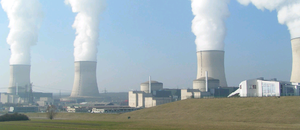
Nuclear power is the use of sustained nuclear fission to generate heat and do useful work. Nuclear power stations work in pretty much the same way as fossil fuel-burning stations, except that a "chain reaction" inside a nuclear reactor makes the heat instead. The video below shows the working of nuclear power plants.

In the early 20th century, it was discovered that radioactive elements release immense amounts of energy and soon the pursuit of nuclear energy for electricity generation began. Over the course of time this was made possible. USSR's Obninsk Nuclear Power Plant became the world's first nuclear power plant for electricity generation.
In the 1960s, the setting up of such plants came to be locally protested in many parts of the world. This soon became an issue of major public protest, reaching an intensity uncommon in 'technology' controversy history. The nuclear power conflict is an ongoing one.
But by 2005, nuclear power stations provided about 6.3% of the world's energy and 15% of the world's electricity, with the U.S., France, and Japan together accounting for about 56.5% of nuclear generated electricity. There are about 436-9 nuclear reactors in the world.
A source of energy, which can be exploited on will, and which will never cause any damage to the environment and ecosystems, is just too good to be true. The recent Fukushima I nuclear accidents, the Chernobyl accident of 1986 and the Three Mile Island accident of 1979 are enough proof.
The Chernobyl accident, which is considered the worst nuclear power plant accident ever, occurred in Ukrain on the 26th of April 1986. It's cause was mainly engineering deficencies and technological faults (the safety systems were switched off when the accident occured). Though the death toll, due to the initial release is between 25-31, the number of deaths due to cancer and contamination is many hundreds of thousands. Now it is a ghost town, not habitable, but with many working reactors. This video gives a detailed account on the events. Follow this link to see the other parts.
So, while such a power source may be less polluting and damaging to the environment and cost effective, it adversely affects lives, not only of human beings. Managing nuclear waste is a major task most nuclear power using countries are not ready to face. 'Human kind cannot bear very much reality' - T.S. Elliot. While it may be an efficient alternative source of energy, if we look a bit further into the future, we'd realize that it'll end up being a huge burden.
Even if countries like America and France rely on nuclear energy more than any other country, where do they dump their wastes? In the less developed ones.
SUBSCRIBE & S P R E A D T H E W O R D !
Request for more essays!
Source: Various websites.
Source: Various websites.


No comments:
Post a Comment